
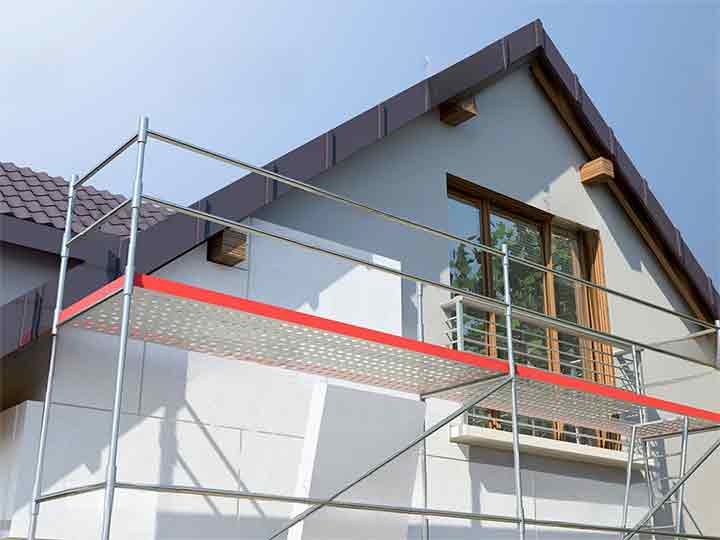
Most homeowners in the Capital Region think of exterior painting as a summer job. July hits, the sun is out, and the peeling trim on the south face of the house finally becomes impossible to ignore.
But summer is not actually the best time to paint a house here. Fall is. And the fall window in Upstate New York is shorter than most people realize.
If your siding, trim, or porch is due for a repaint, the next six to eight weeks are the part of the year when everything lines up: the temperatures, the humidity, the dew point, and the amount of daylight a crew can actually work in. After that, the math stops working.
Why paint quality depends on temperature more than most people think
Modern exterior paints are engineered to cure within a specific range. Most quality acrylic latex products need surface and air temperatures to stay above roughly 50°F — not just at noon, but through the overnight hours while the film is still forming. Some newer formulations drop that floor to around 35°F, but even those need a stable stretch, not a single warm afternoon.
Here’s what happens when paint goes on too cold:
- The film never fully coalesces. The resin particles don’t fuse the way they’re supposed to, which leaves you with a coating that looks fine on day one and starts chalking, cracking, or peeling within a couple of seasons.
- Adhesion suffers. Paint applied to a cold substrate doesn’t bond properly, especially on older wood siding that’s already been through a few repaint cycles.
- Cure time stretches out. A coat that would be dry to recoat in four hours at 70°F might need twelve or more at 45°F, which collapses a crew’s ability to get two coats on in a day.
Cold weather doesn’t ruin a paint job the day it’s applied. It ruins it the following spring, when the freeze-thaw cycle finds every weak spot in the film.
The humidity problem nobody warns you about
Temperature gets all the attention, but in the Mohawk Valley the bigger enemy is moisture — and it isn’t rain. It’s dew.
By late September, overnight lows in Schenectady routinely fall to the dew point. Moisture condenses on every exterior surface after sundown and doesn’t burn off until mid-morning. If a fresh coat is still curing when that happens, you get surfactant leaching — those streaky, blotchy runs that show up on darker colors and look like the house is weeping.
This is why an experienced crew in this region works a compressed daily schedule in the fall: start after the surfaces dry, stop early enough that the last coat has hours of dry time before the temperature drops. A contractor who’s painting until 6:30 p.m. in mid-October either doesn’t know this or is hoping you won’t notice until spring.
Summer, for what it’s worth, has the opposite problem. July humidity and direct sun on a south-facing wall can push surface temperatures well past 100°F, which makes paint skin over before it levels — leaving brush marks, lap marks, and poor penetration.
Fall splits the difference. Cooler air, lower humidity than midsummer, gentler sun angle, and surfaces that stay in the sweet spot most of the working day.
What the fall window actually looks like here
For Schenectady, Niskayuna, Rotterdam, Scotia, and the surrounding Capital Region towns, a realistic planning calendar looks like this:
Late August through September — the ideal stretch. Warm days, cool nights, low rain probability, long enough daylight for two-coat days. This is when the best work gets done.
Early to mid October — still viable, but the schedule tightens. Crews lose usable hours on both ends of the day. Prep work like scraping, sanding, and caulking still goes fine; it’s the finish coats that get constrained.
Late October into November — case by case. Depends heavily on the year, the exposure of the wall, and the product. Some jobs can be done. Many should wait.
December through March — exterior painting is off the table in this climate. This is the season for interior work, drywall repair, and remodeling.
The practical takeaway: if you want exterior painting done this year, the decision needs to happen in the next few weeks, not in November.
Prep is what actually eats the calendar
Homeowners tend to think of a paint job as painting. In reality, on an older Capital Region home — and a lot of housing stock around Schenectady dates to the early twentieth century — prep can be sixty to seventy percent of the labor.
- Pressure washing and letting the substrate dry completely, which can take a day or more on its own
- Scraping and sanding failed coatings
- Repairing rot in trim, sills, and fascia
- Re-caulking joints and seams
- Priming bare wood and any tannin-prone species
- Masking windows, roofing, walkways, and landscaping
Each of those steps has its own weather dependency. Wet wood can’t be primed. Caulk has its own minimum application temperature. A job that takes five days in September can stretch to nine in late October simply because fewer hours each day are usable.
This is the real reason to book early. It isn’t a sales tactic — it’s that the prep phase needs slack in the schedule, and slack disappears as the season closes.
Signs your exterior can’t wait until spring
Some paint jobs are cosmetic and can reasonably be deferred. Others are protecting the structure underneath. Push the project forward if you’re seeing:
- Bare wood showing through. Unprotected wood absorbs water, and a winter of freeze-thaw will do real damage.
- Peeling in sheets rather than flakes. Usually a sign of moisture getting behind the film.
- Soft or spongy trim, sills, or fascia. That’s rot in progress, and it spreads.
- Failed caulk joints around windows and doors. Open seams let water into the wall assembly.
- Chalking so heavy it comes off on your hand. The binder has broken down and the coating is no longer doing its job.
Cosmetic fade, minor discoloration, or a color you’ve simply grown tired of? That can wait for spring without consequence.
Planning your project
If you’re weighing an exterior repaint this year, the sequence is straightforward: get the walkthrough done now, get the estimate in writing, and get on the schedule while the good weather is still in front of you. See our exterior painting cost guide for typical price ranges before you call. If the assessment shows the job is better off waiting until spring, a contractor worth hiring will tell you that directly.
VividPro Painters & Remodeling works throughout Schenectady and the greater Capital Region, handling interior and exterior painting, drywall, and remodeling. We’re based at 2321 Broadway in Schenectady.
Call 347-484-1724 for a free estimate, or request one at vividpropainters.com.
Frequently Asked Questions
What is the coldest temperature you can paint a house exterior?
Most quality exterior acrylic latex paints require surface and air temperatures to stay above about 50°F during application and through the overnight cure period. Some products are formulated down to roughly 35°F, but they still need stable conditions rather than one warm afternoon. In the Capital Region, that practically means the exterior season ends somewhere between late October and mid-November depending on the year.
Is fall a better time to paint than summer?
In Upstate New York, generally yes. Fall offers moderate temperatures, lower humidity than midsummer, and a gentler sun angle, which helps paint level and cure properly. Summer’s main drawbacks are high humidity and direct sun overheating surfaces, which causes paint to skin over before it levels out.
How long does an exterior paint job take?
For a typical single-family home in the Schenectady area, most projects run three to seven working days depending on size, condition, and how much prep and repair is required. Older homes needing extensive scraping, rot repair, or priming take longer. Fall projects can run longer than the same job in September because fewer daylight hours are usable each day.
Can you paint if rain is in the forecast?
Not within a few hours of application. Most exterior coatings need several hours of dry conditions to form a proper film, and some need considerably longer. A good crew works the forecast, not the calendar, and will pause rather than risk a coat that has to be redone.
Should I wait until spring instead?
It depends on the condition of the exterior. If you have bare wood, sheet peeling, soft trim, or failed caulk joints, waiting means a winter of water intrusion and more repair work in the spring. If the issue is purely cosmetic, spring is a fine time to schedule.